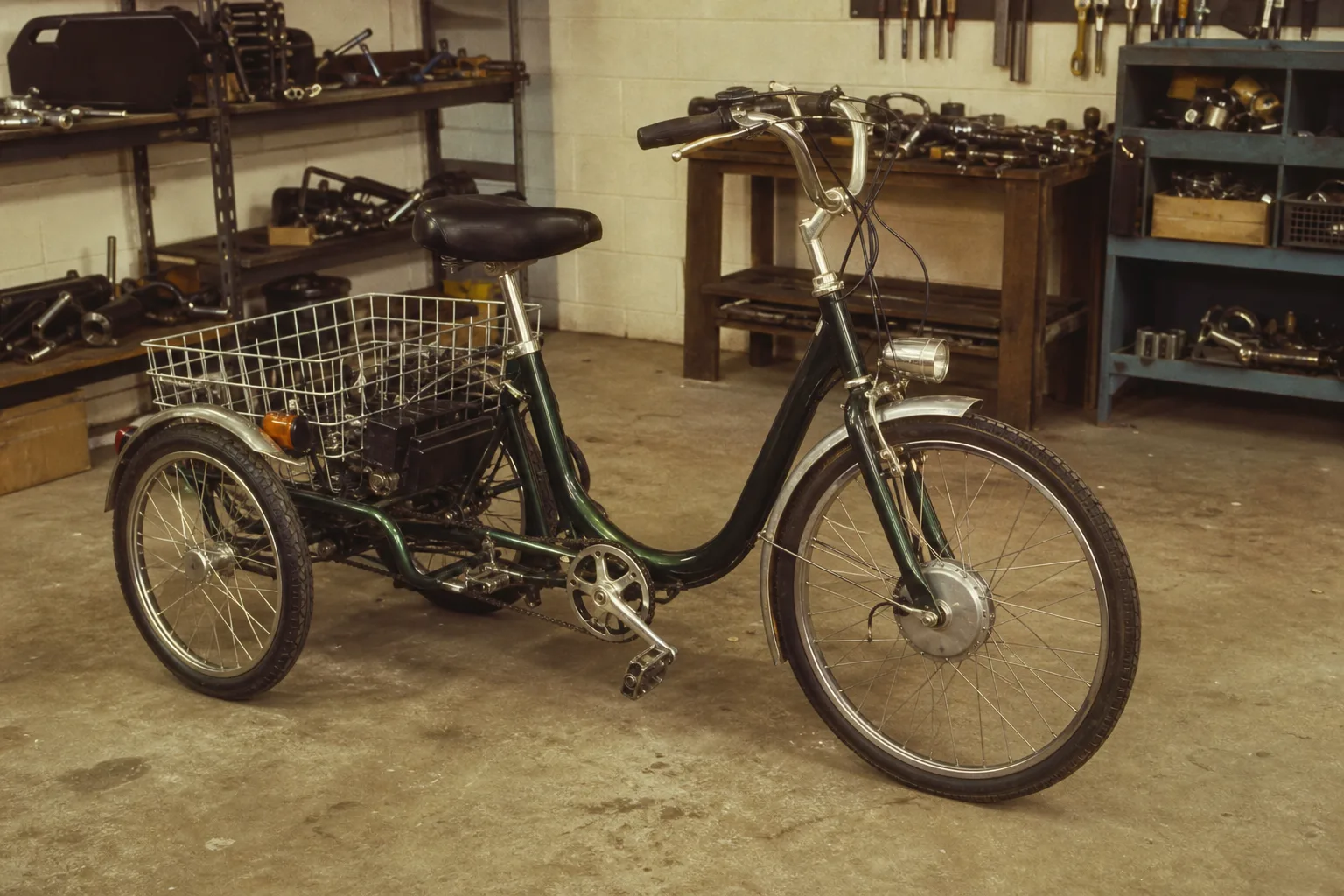
The first year of an adult three-wheeler costs almost nothing beyond the purchase, because everything is new, the tires still have their molding whiskers, and the dealer usually folds a first tune-up into the sale. Year two is where the pattern shows itself, and year three is where the difference between an unassisted trike and a motorized one stops being theoretical. The gap is not evenly spread across every category, either. Two of the four common expenses are nearly identical on both machines, one is modestly different, and one exists on only half of them.
The battery pack, and why it belongs in the budget from day one
A lithium pack on an assisted trike is a wear item with a schedule, not a permanent component, and it is the single largest recurring cost an owner will meet. Capacity fades gradually with charge cycles and calendar age, so the failure looks like a shrinking range rather than a dead machine, which is why many owners do not notice until a familiar route needs a rest stop. Ask the dealer, in writing, what a replacement pack for your exact frame costs today, whether the cell chemistry and connector are still in production, and how long the current supply chain has carried that part number.
Pack pricing spans a wide band depending on voltage, amp-hours, cell brand and whether the housing is proprietary to your frame. What matters more than the number is who can sell it to you in three years. A pack that bolts into a shared, widely used mounting rail will still be orderable when the model is discontinued; a pack molded into a one-off downtube shroud may not be. The Consumer Product Safety Commission oversees product safety for consumer batteries and cycles, and a pack certified to a recognized safety standard, bought from the frame maker or an authorized rebuilder, is the version worth paying for.
Rear tires and tubes, where an easy job turns into a scheduled one
Both wheel counts share this expense, and it surprises people equally. Two rear wheels wear roughly twice as much rubber as one, they carry the cargo box and most of the rider's weight, and on a delta layout the driven wheel scrubs slightly in every turn. The tires themselves are ordinary sizes in most cases, often twenty inch or twenty-four inch, and they are not expensive. Labor is the variable. A rear wheel on a trike does not drop out the way a bicycle wheel does, because the axle passes through a hub carrier, a differential or a solid axle held by bearing blocks.
The careful check is to ask a shop, before you need the work, how long they bill for a rear flat on your specific trike, and whether they have done one. A shop that answers in minutes has done it. A shop that quotes the same as a bicycle rear wheel has probably not looked. Puncture-resistant tires and thicker tubes cost a little more per unit and remove most of the annoyance, which is why so many second-year owners fit them all around after the first roadside education.
Brakes, three of them, on a machine that carries groceries
Cable-actuated disc brakes need pad replacement and cable adjustment, hydraulics need bleeding on a service interval, and a parking brake mechanism adds a fourth thing to check. Assisted trikes go faster and stop heavier loads, so pads wear sooner, and the motor cutoff switches in the levers are one more part that can need attention. Pads are cheap. The labor scales with how many separate calipers a shop has to touch, and a trike almost always has one more than the mechanic expected.
Which shops will take the work
Most independent bicycle shops will service the mechanical side of any trike without hesitation: brakes, tires, bearings, drivetrain. The dividing line falls at the electrical system. Some shops decline motor and battery work outright for liability and training reasons, some service only the brands they sell, and some have a certified technician for one or two motor systems. Call three shops before you buy, name the motor brand and the frame, and ask directly whether they will diagnose a controller fault. The answers you get will tell you what year three looks like more accurately than any spec sheet.
Owners who ask those four questions early tend to find the ongoing costs modest and predictable, spread across tires, pads and one large pack purchase they saw coming. The trike that is cheap to keep is usually the one bought from a shop that still answers the phone.